Potential problems.
Crankpin.
- The 500cc engine suffered from the occasional crankpin breakage, necessary use of pattern single piece crankpins exacerbated this. The purpose of the pin is to keep the rotating and reciprocating engine components together and therefore it is a highly loaded component. Therefore it follows that the pin requires to be made from high strength steel which will withstand shock loads. The construction of the flywheel assembly on a motorcycle also requires that the surface of the pin acts as a bearing surface for the big-end bearings. It must therefore be hard to resist the wear that will occur. This is the problem facing all crankpin designers and manufacturers, the steels that make adequate bearing surfaces, often with a high carbon content, are also rather brittle and will break under shock loads. Steels with lowered carbon content are far less brittle, withstand shocks but don't wear well! So a compromise, as usual, results.
The AMC Crankpin:
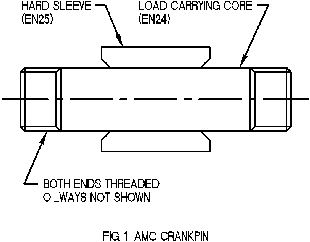
- Fig. 1 shows AMC design. The major loads are carried by the medium carbon - EN24 - steel core. Since this is cylindrical there are no inherent weakening features. Over this is pushed a sleeve of high carbon - EN25 - steel to give a bearing surface and act as a spacer. The machining cost of this design is high (although it is a very neat solution) since it is essential that the sleeve does not move on the inner load-bearing core or wear would rapidly ensue between the sleeve and the pin proper.
The Alpha Crankpin:
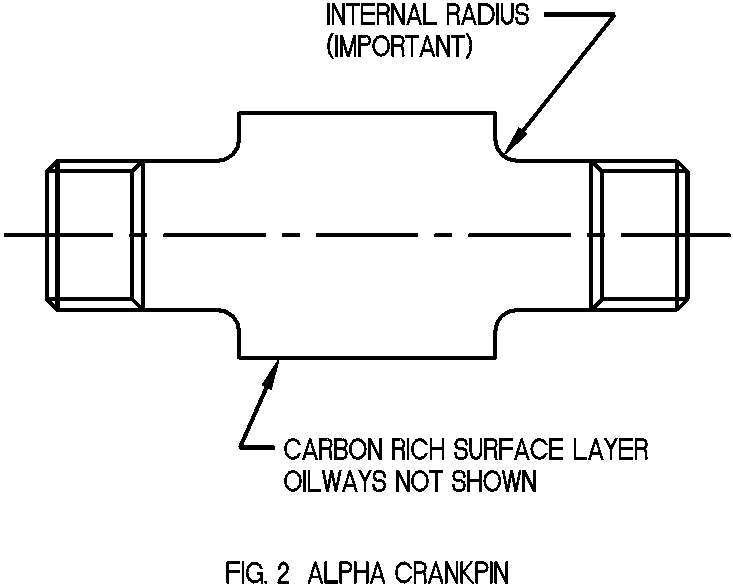
- It must be at least 14 (at the time of writing) years since AMC made the last crankpins, so at any time since then, the manufacture of a replacement crankpin would become commercially viable. The Alpha crankpin, shown in Fig. 2, is just such a commercial replacement. Made of a different steel and following a different practice, the Alpha design is probably cheaper to manufacture, although this is pure surmise.
- Their design utilises a soft core of high load-bearing steel, which is then baked in carbon so that the surface becomes high carbon impregnated and hardens to a bearing surface steel. Any surfaces which do not require to become bearing surfaces are usually masked during the process.
- The penalty of this compromise solution is that there is an internal corner in the design and high stresses are set up because of the loading on the pin. Any weakness in the selected steel or spread of the hardening process can result in minute cracks forming at the point of stress. The bottom of each crack then acts as a secondary internal corner and further cracks will develop with each load point, every second revolution.
- The metal fatigues. A point is reached where the load is fractionally greater than the 'strength' of the metal which has not fatigued remaining at the critical area and the pin breaks. If internal corners were reduced by radiusing, the stress loads would not concentrate at an internal corner. Equally if the loads were reduced they would not be able to create the initial cracks, thus preventing the problem.
- This may be very significant since the Alpha crankpin design and manufacture standards would obviously appear to be identical on the 350 and the 500 units - but only the 500's ever seem to be criticised. Could it be that the loads being: less - the piston being lighter, etc. Is an indication of the selected steel being so critical?
Overcoming the Problems:
Crank Pin
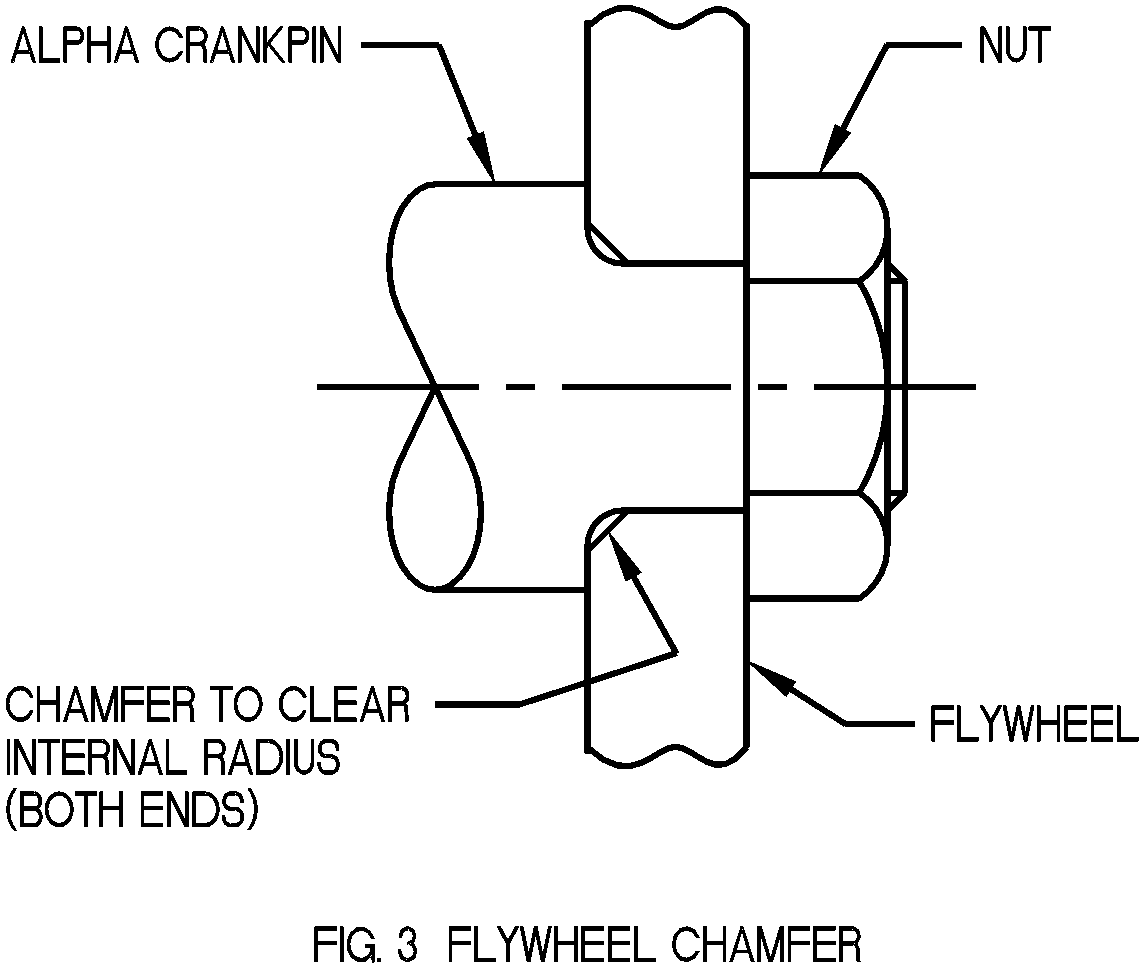
- When AMC designed the flywheel assembly there was no point in chamfering the holes through the flywheel into which the pins fit. The pin and the sleeve were cylindrical and tubular, in that order. When an Alpha crankpin is fitted it must have a radius on the internal corner therefore the flywheels should be chamfered to suit, otherwise pressing the flywheels on to the pin must surely damage the radiused shoulder and guarantee pin failure. The answer, ideally, would be to have Alpha undertake the work themselves - there seems to be no hint of failure of the pin in such circumstances. The chamfering is shown diagrammatically in Fig. 3.
- It is essential that a press is used to assemble the flywheels on to the pin. The nuts on the pin are there to lock the assembly, not to pull it together.
- It could be possible to push the worn bearing sleeve off an AMC crankpin and replace it with a new one. I have heard of people trying this but I am not aware of the results.
- Perhaps the ideal would be for the Club to have crankpins manufactured to the original standards. It would be expensive maybe even twice the cost of an Alpha unit but you pay for what you get and usually you only get what you pay for. (Alpha now produce two piece crankpins to AMC spec.).
Oilfeed boss.
- The boss on the timing side crankcase can be broken by poor spanner work. The threads in the aluminium for the unions can easily strip by cross-threading.
- The oil pipe to the top of the engine can break at the rocker box. Do not use a solid connector when joining the long oil feed pipe to the short rocker box pipe, just a plastic tube with each end crimped with a couple of turns of wire.
Shock absorber spring.
- This can break, particularly if a sidecar is fitted to the bike.
Valve gear wear.
- The contact between the hairpin valve spring and collar wears and to a much lesser extent, the spring tangs and valve spring tray.
Timing pinion cracking.
- The pinion can crack usually due to someone trying to undo the retaining nut and not realising it has a left hand thread.
Inlet valve sticking.
- Carbon from the valve stem oiling can stop the valve from closing. This sticking is often a problem if the bike has not be used for some time.
Piston cracking.
- Pistons can crack either across the dome or around the top ring groove. This is usually associated with pattern pistons and a large right hand. Less serious, in the short term, is skirt cracking from expansion slots on some pattern pistons. Check that the expansion slot has not been machined too deep and cut into the gudgeon pin boss.
Automatic advance and retard.
- The unit used on coil ignition engines should be lubricated by the user, resulting in most now being worn out. To lubricate the unit remove the bolt that holds the unit to the camshaft and inject a couple of shots of engine oil up the centre: Replace the bolt (the timing will not be affected). Do this every few thousand miles. The same applies though not as seriously to the auto advance on the SR1 magnetos.
Rocker box gasket.
- Some pattern gaskets destroy themselves due to the movement between head and rocker box.
Oilpump (not the Norton gear pump).
- The oil pump is almost fool proof, but the one and two start plungers are not interchangeable, likewise the associated 7/8" timing axles. (All plungers with a 1/4" groove and all 1 1/8" diameter timing side axles should be two start.
- A two start axle has two threads on the worm that drives the plunger, just look at its ends. A 3/16" groove two start plunger is more difficult to identify, it should have 2S stamped on it. (If in doubt, mate the plunger and axle together as if they were in the crankcase, when held hard together, they should be square to each other - if not they must not be used together).
- The correct guide pin must be used with the plunger. If there is any flat on the pin, it should be replaced.
- On later engines wear between the plunger and timing side axle can be significant.
- Oil draining into the crankcase from the oil tank indicates a scored pump bore. This can be sleeved by a good engineering shop. If the pump does not return oil to the tank, the fault will either be a blocked oil passage, upstream or downstream of the pump, or air leaking into the scavenge oil passage in the crankcase at one of the screw blanking plugs.
Availability of parts.
- Most wearing engine parts are readily available from either the Club Spares Scheme or the London shops. However, pistons, particularly 500cc ones, have been in short supply and there have been some overweight ones on the market. The weights of the pistons should be about 350 grams - 350cc and 486 grams - 500cc complete with rings and gudgeon pin. Overweight ones should be avoided since the loads on the crankpin are increased, giving short crankpin life, and vibration will be worse.
- To the best of my knowledge, nobody is making new cams. These can be found for sale in reasonable condition. It is often the gears that wear rather than the cam faces.
- Castings are generally easy to obtain although you will find far more 350cc parts available than 500cc. Ideally crankcases should be matched and the timing side one in good condition (no damage to the oil feed boss and threads for the oil unions).
- The coil ignition automatic advance and retard units are no longer available and you are very unlikely to find a good one. This is a major problem. The options seem to be:
- Fix the unit to one position and time the ignition to fully advanced or slightly retarded and accept that the engine may kick back during starting.
- Fix the unit to one position and make a manual advance and retard mechanism using the contact breaker mounting plate. This means drilling a mounting hole in the timing chest for the control cable.
- Convert the electrics to 12 volts and use an electronic ignition system that incorporates an advance and retard operation.
- Parts for the short stroke engines are not as easily available.
AJS and Matchless Owners Club Limited : https://WWW.JAMPOT.COM/
© 2000-2026 Jampot All Rights Reserved.